
Quick explanation__________
Camshafts only produce maximum power over a a few thousand rpm's. Traditionally, a
cam is designed to produce power in the middle of the rpm band at the sacrafice of both
low and high rpm power. Hot rodders put "big" cams into their engines that
make lots of power at high rpm's but the engine runs so bad that it will stall at anything
under 1500rpms. Vtec allows the engine to use 2 different cams. At low rpms it uses
a cam designed for decent power and mileage but as the rpms get higher it actually
switches over to a cam that produces great power in the higher rpm range.
Long explanation__________
So what IS VTEC? VTEC is Honda's trademarked acronym for Variable valve Timing and
Electronic lift Control. Put simply, it's a method of directly altering the cam profile
that valves "see", so that the optimum grind can be utilized at either high or
low rpm. Honda currently has three different VTEC systems for sale in the U.S., but the
primary differences are level of
complexity and design purpose. Since the high performance version is the most often
discussed, I'll describe it: The high performance VTEC system, which made it's debut in
the Honda NSX, later became available on various other models - Integra, Prelude, delSol,
Civic, Accord, etc.
Using radical cam grinds to improve engine horsepower is certainly nothing new, but the
problem lies in driveability. The very aspects of a cam grind that work so well for
horsepower
(high lift, long overlap, etc.) do so by creating an ideal situation for a high air flow
at high engine speeds. Unfortunately, what works well for that situation has the inverse
affect on low speed torque and driveability. Perhaps at one time or another we've all
heard the V-8 hot rod that has a cam grind so radical that it can't even maintain an idle,
and the driver must constantly goose the accelerator to keep the engine running. What to
do? How about two different cam grinds, each optimized for a different half of the rpm
range. Honda achieves this with a rather simple method. Picture, if you will, one cylinder
of a DOHC, 4-valve per cylinder engine. There are 4 cam lobes, each directly operating a
valve (two intake, two exhaust). The VTEC system has two more cam lobes, in between each
pair of the other respective sets. These two can then be our high-rpm lobes, while the
other four are the low-rpm lobes. The low-rpm lobes in this case then actuate the valves
through a set of rocker arms, so that the mechanical connection can be broken if desired.
The third, high-rpm lobe also has it's own follower, but it is in a freewheeling state,
flopping around and not contributing anything. As our engine accelerates through it's rev
range, it passes through the power peak of the low-rpm lobes. Then, at the engine speed
and throttle position programmed into the computer's memory map a signal is sent which
electronically opens a spool valve, which then directs oil pressure to a mechanical
sliding pin. This pin locks the rocker arms actuating the valves to the follower on the
high-rpm cam lobe. As this grind is steeper and higher then the other four cams it will
supersede them. In a few milliseconds you have completely altered the valve timing and the
engine's power band begins anew. The obvious benefits to this are the high-rpm power
associated with a radical cam grind, but with little or no negative affects on low speed
idle, driveability or torque. Just changing a fixed timing engine to a cam grind equal to
the high-rpm one used in the VTEC would produce an engine which is utterly gutless below
5000rpm. Clearly, this system is intended to improve performance first, with little effect
elsewhere. But such a system can be used differently, as that in the Civic VX. In this
instance, the low-rpm lobes give a staggered timing, where one valve opens fully but the
second cracks just a bit. This is to induce a high swirl rate into the chamber to promote
better combustion, which, when combined with a computer-actuated lean burn helps to
achieve high mileage. The high-rpm lobes in this engine are a more conventional grind
associated with a sixteen valve 4-cylinder, to provide extra power in cases of passing or
merging. The VTEC system used in most Civics (EX, Si and the delSol Si but NOT delSol
VTEC) is a little closer to that in the NSX, etc. The difference being that this system is
vastly simplified and operates on the intake valves ONLY. The exhaust valves are actuated
conventionally, which reduces the effect somewhat from the full VTEC system. This is
partly to reduce costs, and partly because this engine is a SOHC, and the complex system
of rocker arms to actuate sixteen valves is prohibitive to the full VTEC system. The VTEC
on the Accord is close in design to that on the Civics as well, optimized more for a
smooth power delivery then high horsepower. The negative effects? Very few, really.
Obviously it's very expensive, with many complex parts involved. The biggest drawback is
the limitation to only two "modes" of valve timing. Most engineers are still
seeking ways to obtain unlimited variance of the valve timing, so that it can be optimized
to any engine speed, not just high or low rpm.
Explanation of the Vtec system available in the 2nd gen CRX
(b16a motor)
The VTEC (Variable Valve Timing and lift Electronic
Control) system is explained here by example of the 1.6 liter DOHC engine
used in the CRX, which was in 1991 the first car equipped with such an
engine. It has four valves/cylinder and two overhead camshafts.
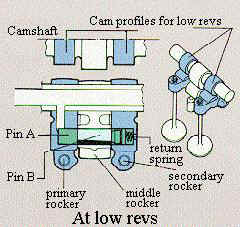 Fig. 2 |
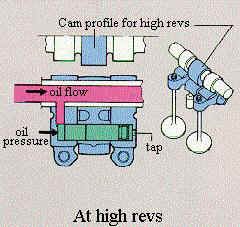 Fig. 3 |
For every cylinder there are three cams on the camshaft and three rockers instead of the
usual two. At low to middle revs the outside in- and output cams are used. They have their
own rockers which operate on accompanying valves. These cams are designed for moderate
lift and timing. (Fig. 2).
At high revs the middle cam is used. It has a high lift and different timing. This cam
operates on the middle rocker. The indirect selection of the two different type of cams is
done hydraulically by shifting a pin, consisting of two parts A and B, in the rockers by
which the middle rocker takes along the two outside ones, which as a result, also receive
the fast middle cam profile. The valves are opened wide and for a longer period for more
power. (Fig.3).
The two cam types have their own power distribution curve. At one point in both curves the
engine delivers the same power. At this point the motor management switches from one state
to the other. As a result the transition occurs smooth and without notice, except for some
more push of course